 Sophia Chen5 min read
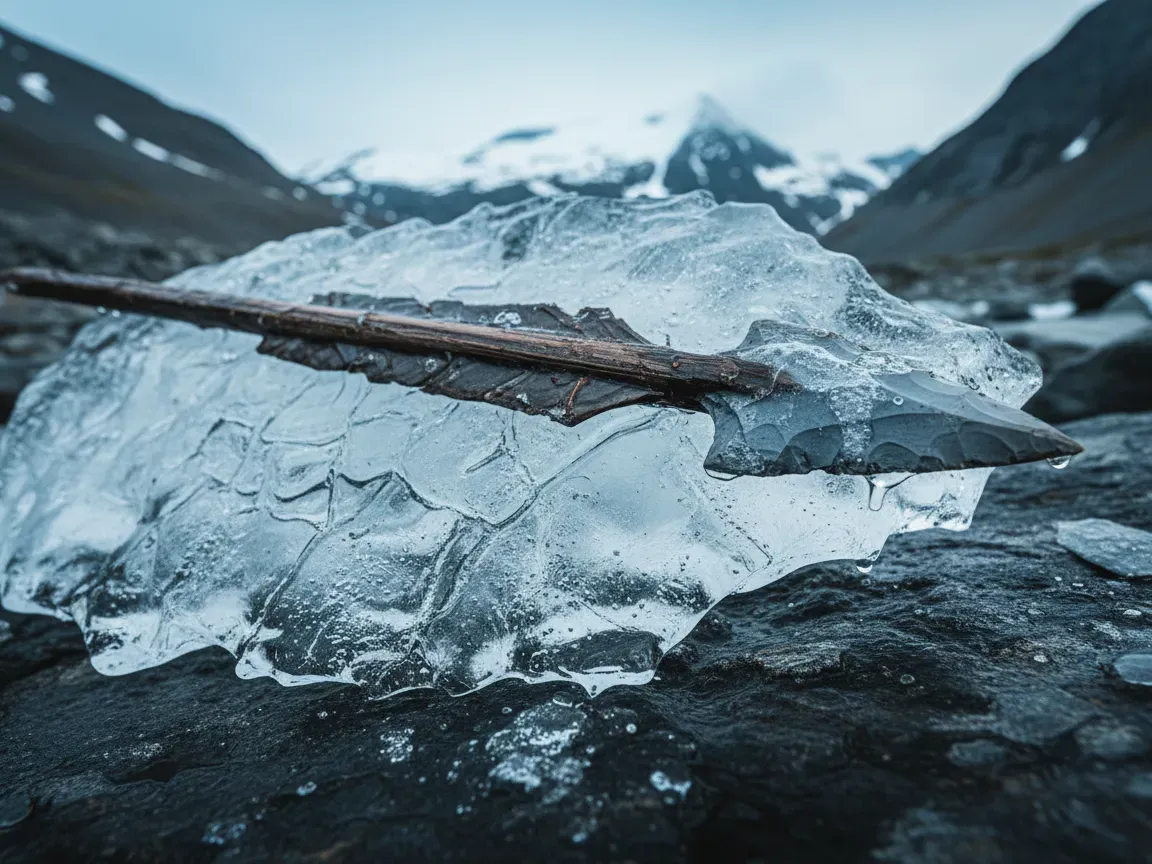
High in the mountains of Norway, retreating mountain ice patches have exposed an intact hunting arrow dating back roughly 5,000 years. Glacial archaeologists working in the Jotunheimen mountain range recovered the Stone Age weapon, complete with its quartzite tip, wooden shaft, and traces of sinew lashing.
While uncovering an untouched relic from five millennia ago is a scientific milestone, the conditions behind its appearance paint a stark picture. The rapid thawing of permanent mountain ice offers a direct view into prehistoric Scandinavian life, yet it also exposes vulnerable organic artifacts to immediate decay.
A 5,000-Year-Old Arrow Emerges from Jotunheimen’s Retreating Ice
The Jotunheimen region contains some of northern Europe’s highest peaks, harboring stationary ice patches that have acted as natural cold storage units for thousands of years. Unlike moving glaciers, which crush and grind materials beneath their immense weight, high-elevation ice patches remain relatively still. This unique freeze-frame environment allows delicate organic remains to stay intact.
Archaeologists monitoring the retreating edges of these ice fields spotted the prehistoric weapon as the frozen surface melted away. Scientific assessments and comparative radiocarbon dating place the arrow squarely in the Late Stone Age. Finding such an old hunting tool in high alpine terrain confirms that prehistoric humans were not merely passing through the valleys; they actively traversed rugged peaks during seasonal hunts.
How Ancient Hunters Trapped Game in High-Altitude Ice Fields?
To understand why a hunter climbed several thousand feet into sub-zero terrain five thousand years ago, one must examine the behavior of reindeer. During the warmer summer months, reindeer gather in dense herds on high-altitude snow and ice patches to escape biting insects and regulate their body heat.
Stone Age hunters recognized this predictable pattern and adapted their tactics accordingly:
- Hunters hiked up through rough scree and snowfields to ambush herds seeking shelter from flies and heat.
- Stone hunting blinds, built from loose alpine rock, allowed archers to conceal themselves within shooting distance.
- Arrows that missed their targets vanished into soft snowbanks, where fresh winter layers buried and froze them within months.
- The low temperatures and lack of atmospheric exposure preserved the wooden shafts, adhesives, and stabilizing feather fletchings.
This specialized alpine strategy remained in use across centuries, leaving behind layers of tools dropped across different cultural eras.
Why Glacial Melting Acts as Both a Time Capsule and a Threat?
The emergence of these artifacts highlights a steep dilemma for modern archaeology. Glacial ice acts as a remarkable time capsule, but it only preserves artifacts as long as it remains frozen. As rising seasonal temperatures strip away centuries of accumulated ice, relics that spent millennia sealed away are suddenly dumped into open air.
The moment an ancient wooden shaft or leather binding melts out of the ice, a destructive countdown begins. Exposure to oxygen, moisture, bacteria, and strong alpine sunlight starts breaking down organic compounds within days. If researchers do not spot and collect these items quickly, wind and seasonal meltwater wash them away or break them down into unidentifiable splinters. Every discovery is simultaneously a rescue mission against fast-moving environmental forces.
Preserving Fragile Wood and Sinew Before Modern Exposure Destroys Them
Recovering an ancient arrow from an alpine slope involves far more than simply picking it up. Uncontrolled drying can cause ancient wood to warp, crack, and shrink within hours, destroying structural clues left by the toolmaker.
Field teams pack specialized gear into the mountains, including padded transport tubes, cold-storage packs, and humidity-controlled containers:
- Field teams carefully wrap thawed artifacts in damp conservation paper to keep moisture levels stable during the descent.
- Laboratory specialists place the wooden shaft and organic bindings into temperature-regulated freeze-dryers to sublimate moisture without collapsing the cell walls.
- Conservators analyze resin adhesives and sinew fibers using modern microscopic tools to see how early communities processed local materials.
- Radiocarbon dating isolates tiny carbon samples from the wood fibers to pinpoint the exact window when the tree was felled.
These systematic preservation steps ensure that long-term study can continue long after the artifact leaves the mountain.
What These Rapid Discoveries Teach Us About Global Warming?
Glacial archaeology provides educational institutions with tangible evidence of environmental shifts. While climate models rely on data charts and satellite projections, a 5,000-year-old arrow melting out of the ground offers a tactile benchmark for modern retreat rates.
Because organic materials decay quickly in the open, the reappearance of a Stone Age tool means the ice enclosing it had not melted since the day it was dropped. The current thaw is cutting into ice layers that remained stable through various historical warm periods, demonstrating that modern alpine ice loss is outpacing historic norms. For educators and students, these recovered items bridge the gap between human history and environmental science, showing the direct impact of sustained global warming on non-renewable historical archives.
Ways to Support and Explore the Expanding Field of Glacial Archaeology
The rapid rate of mountain thaw has transformed glacial archaeology into an urgent, field-intensive discipline. Educational organizations and outdoor enthusiasts both play important roles in documenting and protecting these alpine sites before winter snows or exposure wipe them away.
- Public education programs now train alpine hikers and mountaineers on how to photograph and report high-altitude artifacts without disturbing the surrounding context.
- University field schools organize dedicated seasonal surveys across vulnerable ice edges during late summer, when melt rates peak.
- Digital heritage platforms upload detailed 3D photogrammetry models of recovered tools, letting students around the globe examine prehistoric craftsmanship.
- Interdisciplinary research grants fund joint expeditions where glaciologists and archaeologists map disappearing ice layers together.
Coordinated field reporting and open digital records allow researchers to keep pace with changing mountain landscapes.
Rethinking Our Approach to Disappearing Cultural Records
The recovery of ancient hunting gear from Norway’s highest peaks proves that ice patches hold some of the world’s most delicate historical records. Each arrow, spear shaft, and piece of clothing shows how early societies understood animal behavior and adapted their technology to harsh mountain conditions. These finds change how classrooms discuss prehistoric life by demonstrating that early hunters actively utilized high alpine ecosystems.
At the same time, every rescue operation signals the steady disappearance of the permanent ice that kept these artifacts intact for millennia. Educational institutions and conservation teams face a narrowing window of time to locate, record, and stabilize these fragile objects. Finding effective ways to balance immediate field recovery with broader climate research will determine how much of this frozen archive survives for future generations to study.
AuthorSophia Chen
Learning Strategist
Sophia Chen focuses on practical learning strategies and effective study techniques. She shares insights on how to optimize the learning process for academic success and lifelong skill development, drawing from her background in educational psychology. Sophia is passionate about making education accessible and empowering individuals to achieve their personal and professional development goals.